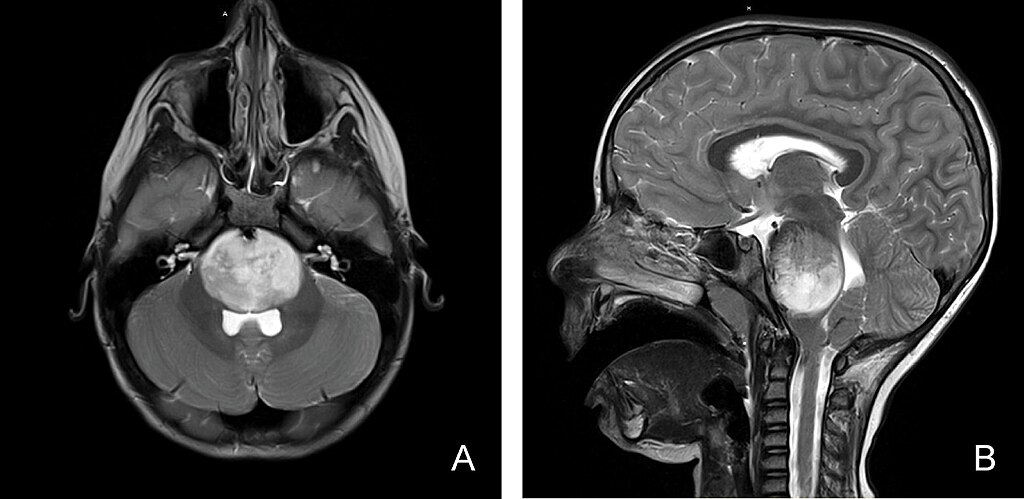
Prominent Meckel's
The brain and spinal cord are covered by three protective membrane-linings called meninges. The dura mater is the tough outermost layer. Meckel’s cave is a dura mater pouch filled with cerebral spinal fluid (CSF) at the base of the skull that contains the root of the trigeminal nerve (responsible for sensation of the face and movement in the jaw muscles). A prominent (enlarged) Meckel’s cave is a nonspecific finding (meaning it is difficult to say what the cause is).
Hemosiderin deposits
Hemosiderin is an iron-containing substance that is formed from the hemoglobin of disintegrated red blood cells. Hemosiderin deposition refers to the stain left behind on brain tissue by blood from a brain bleed. Cerebral microbleeds are small chronic brain hemorrhages, likely caused by structural abnormalities of the small vessels in the brain. Extensive research has demonstrated the value of cerebral microbleeds as markers of small-vessel disease (i.e. microvascular ischemic disease). The cause of microvascular ischemic disease is not completely understood, but can be the result of plaque buildup and hardening (atherosclerosis) of the small blood vessels nourishing the brain. This is the same process that can narrow and damage heart blood vessels.
T2 white matter hyperintensities
White matter is the brain tissue that contains nerve fibers and serves as the connection to other parts of the brain. White matter hyperintensities are common changes seen on MRI in asymptomatic individuals (those with no symptoms), and their prevalence increases with age, to nearly 100% in those older than 90 years. The possible causes of white matter hyperintensities include chronic microvascular ischemic changes, vasculitis (blood vessel inflammation), migraine, Lyme disease or demyelinating disease.
choroid plexus cysts
The choroid plexus is a secretory tissue found in each of the brain ventricles (a communicating network of cavities filled with cerebrospinal fluid [CSF] and located within the brain tissue), the main function of which is to produce CSF. Cysts of the choroid plexus are common, benign (non-cancerous) lesions. In almost all cases these cysts are asymptomatic (do not cause symptoms), but sometimes can cause headaches, neurologic deficits, or seizures.
post traumatic contusions
Brain contusion (bruise) is a type of intracerebral hemorrhage (bleeding within the brain tissue itself) and common in the setting of traumatic brain injury (TBI).
Retro-cerebellar arachnoid cyst
The cerebellum is the area at the back and bottom of the brain, behind the brainstem (where the spinal cord meets the brain). The retro-cerebellum is the area just behind or below the cerebellum.
The brain and spinal cord are covered by three protective membrane-linings called meninges. Sometimes, for unclear reasons, extra cerebral spinal fluid (CSF) can collect under the middle membrane - the arachnoid membrane. This leads to the formation of a benign (non-cancerous) collection of fluid called an arachnoid cyst. Arachnoid cysts account for approximately 1% of intracranial masses.