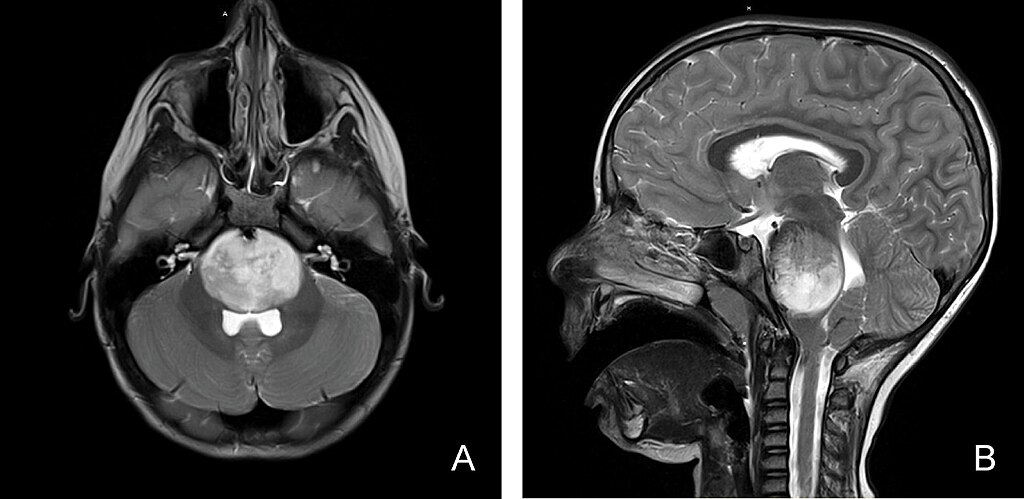
Meningioma
Meningiomas are the most frequent primary brain tumors, however, most are benign (non-cancerous). A meningioma is a tumor that forms on membranes, called meninges, that cover the brain and spinal cord. The underlying cause is not well known but exposure to ionizing radiation is the most important risk factor for meningioma formation. Most asymptomatic (do not cause symptoms) meningiomas remain either the same size or grow very slowly over a long time. Sometimes a meningioma, because of its size and/or location, can cause symptoms including visual changes, extremity weakness, confusion or seizures.
Encephalomalacia
Encephalomalacia describes softening of brain tissue, usually from a past stroke, trauma or infection, or could be congenital (from birth). The most common cause of encephalomalacia is stroke, which has the same major risk factors that lead to heart disease (high blood pressure, poor cholesterol levels, diabetes and smoking).
Focus of signal abnormality
A localized area (i.e. focus) that appears abnormal on MRI brain images. This finding is nonspecific, meaning it is difficult to say what caused it.
Gliosis
Glial cells are the support and insulating cells for neurons (which conduct electrical impulses in the central nervous system). Gliosis is when the body creates more or larger glial cells in reaction to some injury to the brain or spinal cord. Any injury (such as physical trauma) or inflammatory process (such as an autoimmune condition) of the central nervous system can cause gliosis; however, the role of the process is unknown.
Arachnoid granulation
The brain and spinal cord are covered by three protective membrane-linings called meninges. The arachnoid membrane, named for its spider web-like appearance, is the thin middle layer. Blood and fluid are drained from the brain through sinuses. The superior sagittal sinus runs midline in the brain and is the largest dural venous sinus (a group of blood channels that drains blood from the brain).Arachnoid granulations are projections of the arachnoid membrane (i.e. villi) into the dural sinuses.
Arachnoid granulations act as one-way valves, allowing cerebrospinal fluid to pass from the subarachnoid space into the venous (blood) circulation. They increase in size and number with age and are seen in approximately two-thirds of the population.
Lacunar stroke
A lacunar stroke (infarct) is when blood flow going to the small arteries deep inside the brain become blocked. The major risk factor for getting lacunar strokes is chronic high blood pressure, which can cause the small arteries to narrow over time; other modifiable risk factors include poor cholesterol levels, diabetes and smoking.
If there is a new stroke, think “FAST” - Facial drooping, Arm weakness, Speech difficulties, Time is of the essence - call 911. Treatment is focused on restoring blood flow to the brain.